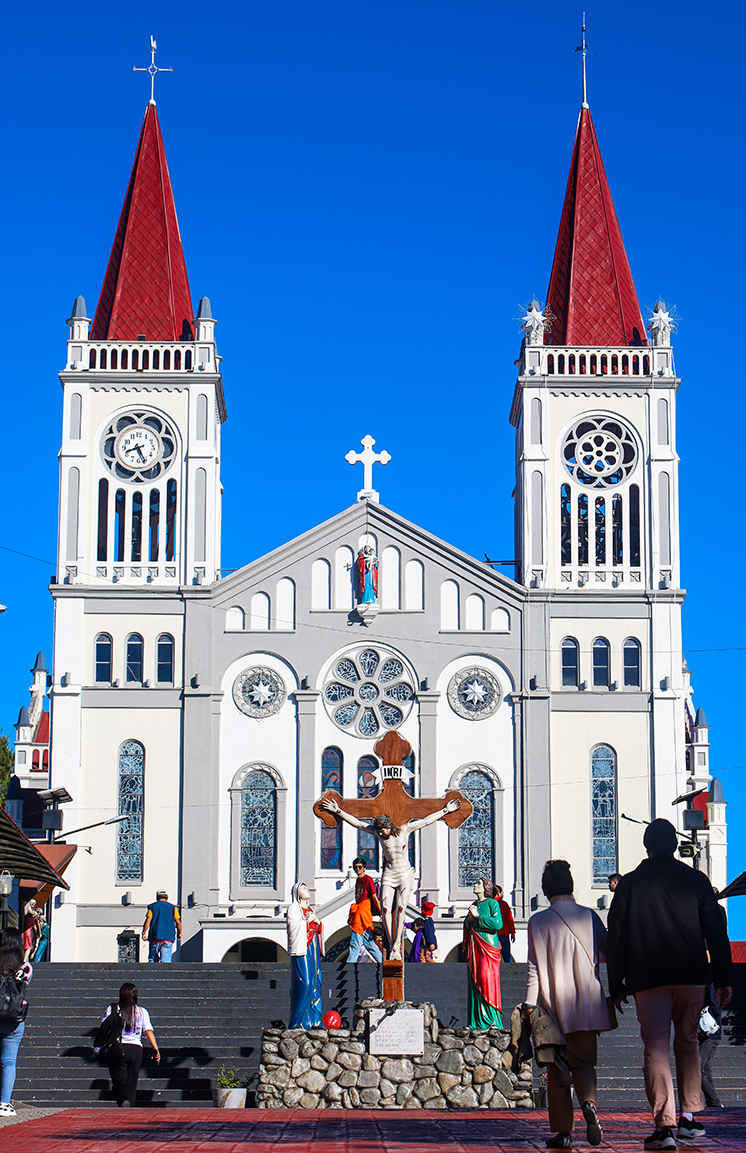
The Our Lady of the Atonement Cathedral, commonly known as the Baguio Cathedral, holds a significant place in the history and culture of Baguio City. Here's a look at its history:
Early Beginnings:
The site where the cathedral stands today was originally a hill called "Kampo" by the indigenous Ibaloi people.
In 1907, Belgian missionaries from the Congregatio Immaculati Cordis Mariae (CICM) established a Catholic mission and named the site Mount Mary.
The first chapel was dedicated to St. Patrick.
Construction and Dedication:
Construction of the cathedral began in 1920 under the leadership of the parish priest, Fr. Florimond Carlu.
The church was designed with a Neo-Romanesque architectural style, featuring twin spires and a distinctive pink facade.
It took the efforts of 25 Igorot carpenters and several CICM priests and brothers to build the church.
The cathedral was completed and consecrated on July 9, 1936, and dedicated to Our Lady of the Atonement, becoming the first church in the world with this dedication.

World War II and Resilience:
During the Japanese occupation in World War II, the cathedral served as a vital evacuation center for refugees.
Remarkably, it was the only building in Baguio that withstood the extensive carpet bombing of the city by American forces in 1945.
Post-War and Present Day:
After the war, the cathedral was repaired and has remained a significant religious and cultural landmark in Baguio City.
In 1986, during the People Power Revolution in Manila, anti-dictatorship organizers in Baguio sought refuge and gathered in the cathedral grounds, contributing to the peaceful protests against the Marcos administration.
Today, the Baguio Cathedral stands as the seat of the Diocese of Baguio and continues to be a central place of worship, a popular tourist attraction, and a symbol of faith and resilience for the people of Baguio.
The dedication to Our Lady of the Atonement is significant. The title was first invoked by Father Paul Wattson, S.A., an Episcopalian priest who later converted to Catholicism, emphasizing Mary's role in unity and reconciliation. The feast day of Our Lady of the Atonement is celebrated on July 9th. 1
An architectural style is characterized by the features that make a building or other structure notable and historically identifiable. A style may include such elements as form, method of construction, building materials, and regional character. Most architecture can be classified as a chronology of styles which change over time reflecting changing fashions, beliefs and religions, or the emergence of new ideas, technology, or materials which make new styles possible.

Turpis in eu mi bibendum neque egestas congue quisque. Eu non diam phasellus vestibulum lorem.Excepteur sint occaecat cupidatat non proident, suntin culpa qui officia deserunt mollit animid est laborum.Phasellus imperdiet lacinia nulla, malesuada semper nibh sodales quis, Duis viverra ipsum dictum.
An architectural style is characterized by the features that make a building
An architectural style is characterized by the features that make a building
An architectural style is characterized by the features that make a building